May 29, 2026

Domain-Specific AI in ERP: Why Generic AI Is Not Enough

Domain-Specific AI in ERP: Why Generic AI Is Not Enough

General LLMs process text efficiently, but applying them to complex Enterprise Resource Planning (ERP) often fails in accuracy, while creating specific data risks. Even with these drawbacks, AI integration in business is not slowing down. Gartner predicts 40% of enterprise applications will adopt task-specific AI agents by late 2026. For these AI implementations to be successful, models need secure access to financial data, approval hierarchies, and inventory records. Domain-specific AI in NetSuite fills this gap between language models and operating needs by connecting natively to unique permissions and accounting rules. This ensures AI agents execute complex operational tasks within established governance frameworks.

In this guide, we’ll go over how domain-specific AI integrates with core business operations. We will also cover NetSuite’s AI features and explain the exact preparation steps your team needs to take for smooth ERP AI implementation.

What Is Domain-Specific AI in ERP?

Domain-specific AI grounds responses strictly in business logic and systems, mapping user requests directly to financial tables, operational sequences, and active user permission sets. To function effectively, AI agents in NetSuite learn the rules of your specific industry and apply your exact business parameters to every output. Teams can then configure these agents to take advantage of NetSuite’s various accounting features, like handling structured financial data alongside multi-step approval processes. Ultimately, these systems rely on unified business data to function, as clean relational databases give the software a reliable foundation for its decision logic.

Why Generic AI Fails in ERP

​​Public large language models generate polished text responses based on external training data. However, ERP AI workflows require accuracy alongside strict auditability.​​​

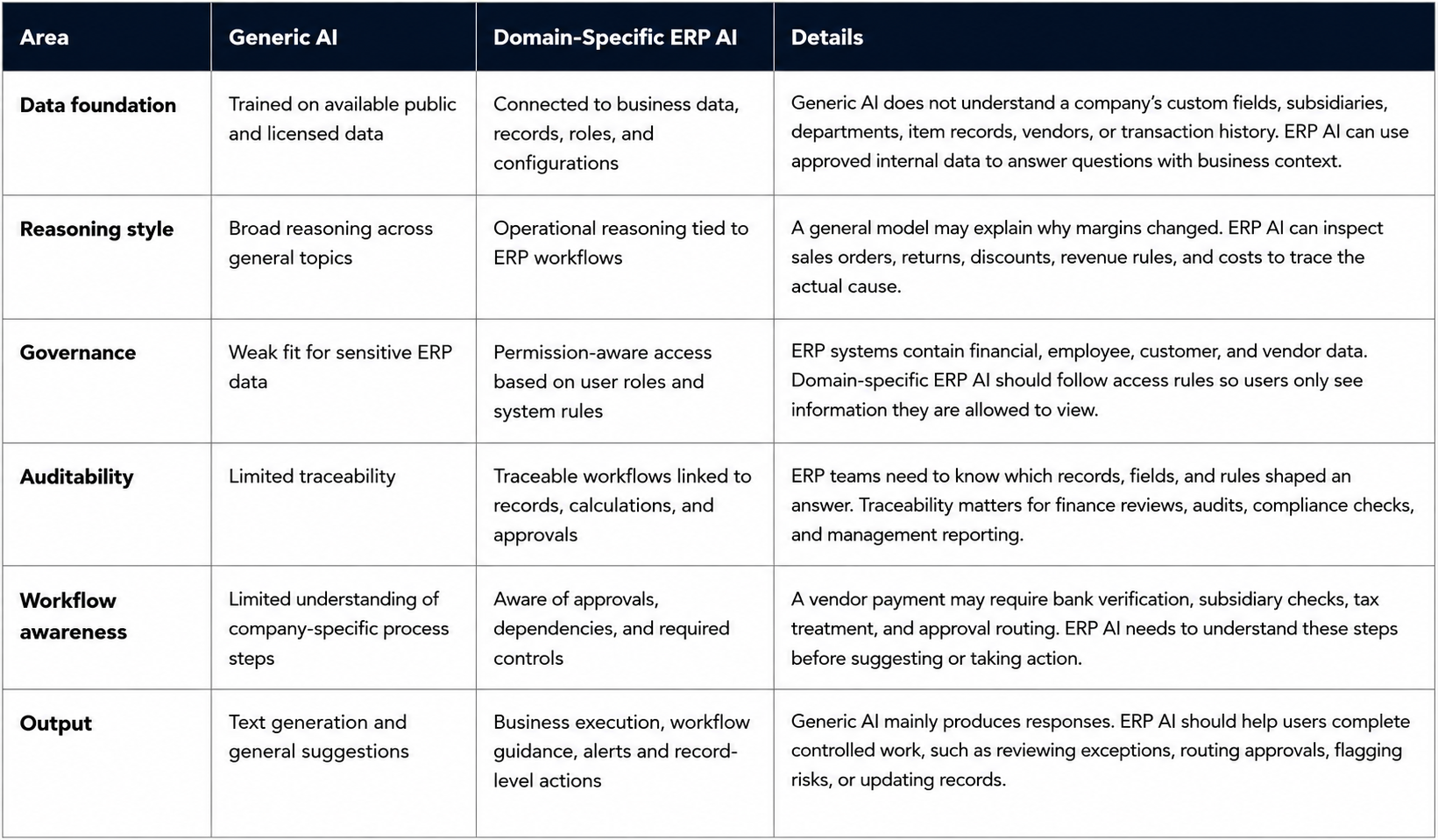
Area Generic AI Domain-Specific ERP AI Details
Data foundation Trained on available public and licensed data Connected to business data, records, roles, and configurations Generic AI does not understand a company’s custom fields, subsidiaries, departments, item records, vendors, or transaction history. ERP AI can use approved internal data to answer questions with business context.
Reasoning style Broad reasoning across general topics Operational reasoning tied to ERP workflows A general model may explain why margins changed. ERP AI can inspect sales orders, returns, discounts, revenue rules, and costs to trace the actual cause.
Governance Weak fit for sensitive ERP data Permission-aware access based on user roles and system rules ERP systems contain financial, employee, customer, and vendor data. Domain-specific ERP AI should follow access rules so users only see information they are allowed to view.
Auditability Limited traceability Traceable workflows linked to records, calculations, and approvals ERP teams need to know which records, fields, and rules shaped an answer. Traceability matters for finance reviews, audits, compliance checks, and management reporting.
Workflow awareness Limited understanding of company-specific process steps Aware of approvals, dependencies, and required controls A vendor payment may require bank verification, subsidiary checks, tax treatment, and approval routing. ERP AI needs to understand these steps before suggesting or taking action.
Output Text generation and general suggestions Business execution, workflow guidance, alerts and record-level actions Generic AI mainly produces responses. ERP AI should help users complete controlled work, such as reviewing exceptions, routing approvals, flagging risks, or updating records.

TABLE and some info missing- not clear

Support for Domain-Specific AI in NetSuite

Oracle NetSuite centralizes organizational data into one unified suite to create a single source of knowledge. This provides the exact context required for intelligent automation, allowing the NetSuite AI architecture to leverage this unified data and power specific features natively.

NetSuite Next and Ask Oracle

NetSuite Next embeds conversational interfaces directly into the financial software. Within this ecosystem, Ask Oracle gives users a natural language search tool for their enterprise data. Users type questions normally to navigate records and analyze financial subsets.

  • The platform then visualizes the data and explains the reasoning behind its answers.  
  • Users can initiate specific domain-specific AI workflows directly within Ask Oracle, where every automated action strictly follows the existing user roles and permission sets.

AI Connector Service and Governed Access

Connecting external intelligence tools requires rigorous security protocols. To handle this, the NetSuite AI architecture uses the Model Context Protocol, which creates a secure, standardized connection between external models and internal business data.

The AI Connector Service gives developers strict control over data visibility so administrators can define the exact records an external model can read. This governed connection allows organizations to deploy ERP AI workflows safely, as the system maintains complete role-based access controls during all automated data exchanges.

Domain-Specific AI Use Cases Across ERP

Deploying domain-specific AI in NetSuite accelerates operations across multiple departments.
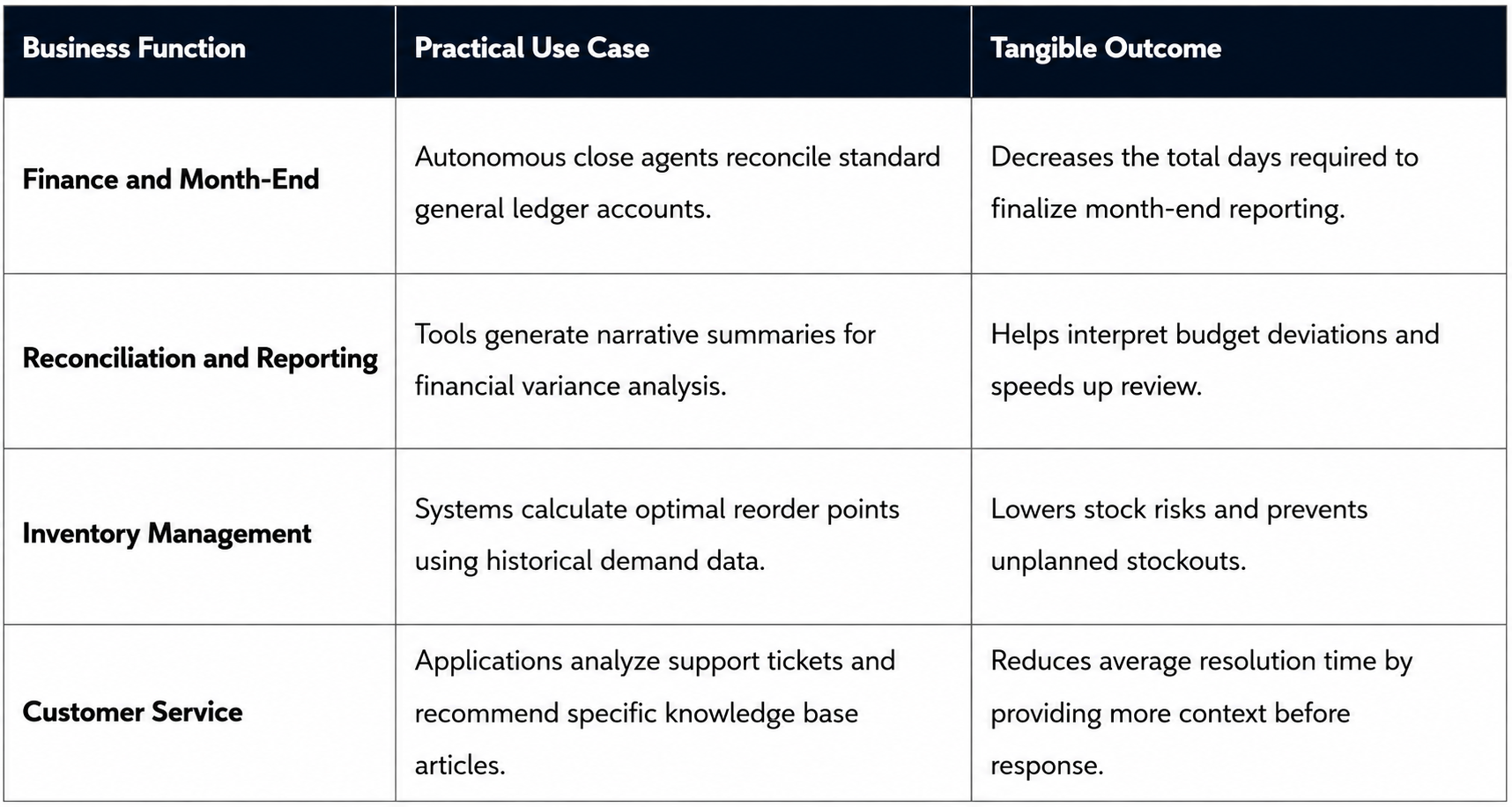
Business Function Practical Use Case Tangible Outcome
Finance and Month-End Autonomous close agents reconcile standard general ledger accounts. Decreases the total days required to finalize month-end reporting.
Reconciliation and Reporting Tools generate narrative summaries for financial variance analysis. Helps interpret budget deviations and speeds up review.
Inventory Management Systems calculate optimal reorder points using historical demand data. Lowers stock risks and prevents unplanned stockouts.
Customer Service Applications analyze support tickets and recommend specific knowledge base articles. Reduces average resolution time by providing more context before response.

AI Integrations in Popular ERP Platforms

Along with NetSuite, other major ERP software providers also recognize the necessity of deep business context, constructing their tools around structured process expertise. However, the differences in how they approach agentic workflow integration in their platforms can be a leading indicator of where they see AI providing most value to businesses.

ERP Vendor Strategic AI Positioning Indication
Oracle NetSuite Unified data, Ask Oracle, AI Connector Service, and strict role-based governance. System value relies heavily on unified database integrity and structured permissions.
SAP Joule Agents built specifically for core functions and connected operational processes. Enterprise technology demands deep business process expertise.
Microsoft Dynamics 365 Systems combine standard tools with custom finance and operations agents. Complex financial operations require specialized operational configurations.
Workday Illuminate Tools process human resources and financial data to manage workforce planning. Domain-specific AI in ERP solves distinct departmental challenges.
Sage Copilot Software trained on accounting principles to detect anomalies. Financial teams require tools explicitly designed for accounting logic.

Preparation Before Adopting ERP AI

Successfully deploying domain-specific AI in NetSuite can be done reliably with structured preparation at the system-level. Organizations must formalize their internal data before activating autonomous agents by taking the following steps:

  • Audit current database hygiene by eliminating duplicate vendor records and standardizing naming conventions.
  • Document all existing approval chains, as domain-specific AI in NetSuite need explicitly defined escalation paths.
  • Review current user permission sets to map exact visibility rules for all employee roles.
  • Assess existing custom scripts to determine how new ERP AI workflows will interact with your legacy customizations.
  • Establish clear human review protocols by defining the exact thresholds that trigger mandatory manual approvals.

Key Takeaways

  • Autonomous agents require structured business context to execute tasks accurately.  
  • Domain-specific AI workflows map directly to your financial configurations, inventory structures, and security protocols.  
  • Designing clear governance policies allows your organization to deploy these tools securely.  
  • ​​Implementing domain-specific AI in NetSuite provides a measurable operational advantage.​

Businesses evaluating AI agents in NetSuite typically begin with workflow mapping, permission reviews, and data quality assessment before enabling autonomous workflows.​​

​​​Tvarana helps your teams assess operational readiness and design governed AI workflows aligned with existing finance and operational controls.​​

FAQs

Domain-specific AI in ERP processes information using precise business rules by connecting natively to financial data, operational sequences, and active user permissions. These systems understand custom fields, chart of accounts structures, and industry terminology to execute exact business operations safely.

Generic tools generate text based on broad public datasets and lack domain-specific business knowledge. ERP tasks require accuracy, strict audit trails, and a deep understanding of rigid transactional dependencies.

Oracle embeds capabilities directly into its unified dataset through NetSuite Next. Ask Oracle allows natural language queries of actual business records, while the underlying NetSuite AI architecture enforces strict role-based access controls.

No, domain-specific AI provides logic and reasoning while AI agent is the software tool that executes tasks using that specialized business intelligence.

Organizations must audit their core data hygiene to eliminate duplicate records. Teams also need to document current approval hierarchies and review active user permission sets.

​​Your ERP is ready for domain-specific AI when its data, permissions, workflows, and integrations are structured enough for AI to act with context and control. The goal is to make sure AI can read the right records, follow the right rules, and support users without creating risk. ​​​

Author:
Athira Nair | CEO / Chief Technology & Innovation Officer, Tvarana