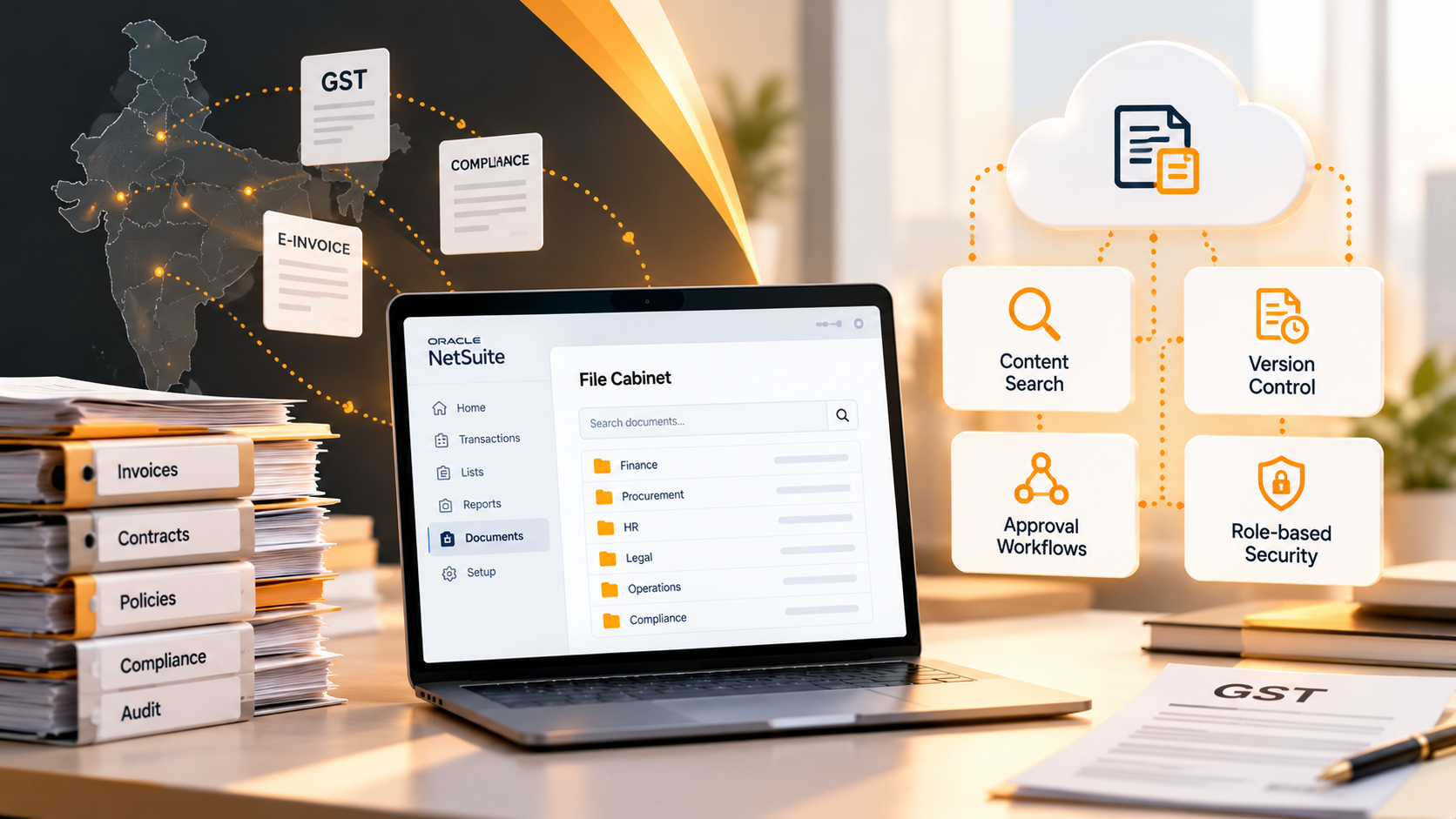
Quick Answer: NetSuite's native File Cabinet wasn't built for the document load that GST, e-invoicing, and multi-entity operations create. It caps file sizes, can't search inside documents, and has no version control or approval routing. The right document management for NetSuite closes those gaps with scalable cloud storage, content search, versioning, approvals, and role-based security all inside NetSuite. Choose one on usability, compliance readiness, version safety, and search efficiency.
Quick Takes:
Growth shows up as orders. More orders mean more to manage: raw material procurement, inventory, storage, financial management, and more. All of it runs on quick, reliable access to accurate data at any time. That only works when your documents are organized and easy to find. NetSuite ERP handles a lot of this out of the box.
But does NetSuite cover everything?
Unfortunately, it does not. Limited storage, file size restrictions, and other constraints make document management on NetSuite a challenge. However, where there is a problem, there is a solution.
Document management for NetSuite closes these gaps through unlimited and scalable cloud storage, stronger security, faster retrieval, and more, all while staying connected to NetSuite workflows. The question is which file management product to pick. This guide walks you through it, with a checklist at the end for quick decisions.
NetSuite Document Management System (DMS) is an integrated solution available in the NetSuite ERP. It allows storage, organization, and management of business documents within the NetSuite platform, accessible through:
But the native DMS is fairly basic. It works better as a transaction tool than a true document management solution. That's why many companies add an external or advanced DMS. It integrates with NetSuite and brings stronger control, automation, and scale along with the document handling Indian companies specifically need.
Document management is never just an operational convenience but a regulatory necessity. Central and state government regulations demand that businesses maintain accurate, accessible, and audit-ready records at all times. But compliance is only one part of it because as businesses grow, the document management challenges they face multiply. Here is a closer look at where the gaps begin to show.
Mandatory GST Registration
The moment a business crosses the applicable GST turnover threshold, the paperwork begins, and it does not slow down. Invoices, credit notes, and supporting documents start accumulating with every transaction. NetSuite's native storage, however, is not built to keep pace with this volume. In many cases, your business may find the storage filling up well before the operations truly scale. What follows is an unplanned cost: purchasing additional storage just to keep basic document management functional. That is an inefficiency you shouldn't have to pay for.
Heavy Documents
Day-to-day business involves more than just invoices. Contracts, business plans, and Standard Operating Procedures (SOPs) are large, detail-heavy documents that teams rely on regularly. NetSuite's native 10 MB limit on everyday drag-and-drop uploads means these files often can't go in through the normal workflow. The result is a fragmented workflow where critical documents live outside the ERP system. This leads to their disconnect from the very records and transactions they belong to.
Version Control
In a growing business, documents evolve, company policies get updated, Safety Data Sheets (SDS) are revised and operational guidelines change over time. When this happens, the ability to retrieve a previous version is both helpful and essential. NetSuite's native DMS does not track versions. Without it, your teams risk working from outdated files, and the result is operational errors, miscommunication, and, in regulated industries, serious compliance risk.
Content Search
A growing document library is an asset until you cannot find what you are looking for. NetSuite's native search keeps things too simple. Users can search by file name or basic tags, and that is largely where the capability ends. There is no support for searching content within documents themselves.
Consider what this means in practice. An employee hunting for a clause in a vendor contract, or a figure buried deep in a financial report, has to open file after file until the right one turns up. During routine operations, this is a time drain. But during audits or time-sensitive business decisions, it becomes something far more costly.
Review and Approval
Most Indian businesses do not operate on trust alone when it comes to documents. Before a file can be used, shared, or signed off on, it typically needs to pass through defined review and approval stages. This is how organizations maintain governance, ensure accountability, and protect themselves from errors that slip through unchecked.
NetSuite, however, does not offer a built-in workflow for this. There is no native way to route a document through an approval chain within the platform. Businesses that need it have to build it themselves with SuiteScript. It means involving developers, managing custom code, and maintaining that solution as the business evolves. If your teams are already managing a full workload, this is an added layer of cost and complexity that should not be necessary.
Indian companies need a NetSuite file management system that aligns with country-specific requirements. Here is what to consider as a must-have:
GST registration is mandatory in India for businesses whose annual turnover exceeds INR 40 lakhs for goods and INR 20 lakhs for services in most states. Note that thresholds vary for special category states and certain business types; businesses should verify applicable limits with a tax advisor.
Given the volume of GST-related paperwork this generates, document management for NetSuite must be capable of storing and organizing all GST-related records. This includes invoices reflecting CGST, SGST, and IGST breakdowns, credit and debit notes, and supporting documents. The system must ensure easy accessibility during audits or GST scrutiny.
E-invoicing is another mandatory requirement for businesses exceeding an annual turnover of INR 5 crores. So your NetSuite document management and storage has to support the e-invoicing framework within NetSuite, especially for B2B transactions. It must store and manage e-invoicing outputs or attachments such as IRN PDFs, QR codes and acknowledgment files generated by NetSuite’s e-invoicing or India localization tools.
Indian companies often operate under multiple subsidiaries, branches, or GST registrations. Therefore, document management in the cloud must support multi-entity document segregation and control within NetSuite. The right solution links each document to the correct subsidiary, customer, vendor, or transaction record. This prevents cross-entity document mixing or misfiling and enables quick retrieval during entity-specific audits or GST scrutiny.
Sensitive financial and business documents call for strong data security and tight access control. The safest bet is a system that meets globally recognized compliance standards, such as ISO 27001 for information security, GDPR for data privacy, and SOX for US-listed entities.
Such a choice provides security aligned with internationally recognized regulatory frameworks. The document management system must also enforce role-based access controls, ensuring that only authorized users can view, edit, or share specific documents.
No company works in isolation. Teams collaborate with vendors, auditors, and clients every day, so secure collaboration features are non-negotiable. The DMS should let external parties securely view, upload, and approve documents without requiring full ERP access or an additional NetSuite license. This removes dependency on internal users for every document exchange and enables smoother, faster workflows.
Version safety is another important feature to evaluate when selecting a document management system for NetSuite. While someone is editing a document, a temporary file lock should stop others from making conflicting changes at the same time. Think of it like a library reservation: the file stays locked out for one person until they release it, so its integrity is maintained.
When selecting a NetSuite document management system, a fast preview feature significantly adds to operational convenience. It allows instant access to contracts, invoices, and SOPs without the need to download files first, so professionals can decide and share faster. That saves time otherwise lost to file handling during daily workflows and audits.
A document management system is only as good as how easy it is to use. If uploading files feels like a task in itself, employees will find workarounds, and the system will quietly lose its purpose. A NetSuite DMS that supports drag-and-drop uploads removes the friction entirely. So, no clicking through menus, no hunting for the right folder, just a quick way to get documents where they belong.
Beyond uploading, organization matters just as much. When every document tied to a NetSuite record sits together in one clean view, teams juggling piles of invoices, purchase orders, and compliance files move faster and with more confidence.
Storage is easy to ignore until it becomes a problem. By then, operations are already affected. As a company grows, so does its document footprint. GST invoices, contracts, audit records, and transactional files accumulate steadily, and a system that cannot keep up will eventually become a bottleneck.
This is why scalable, cloud-based document management is foundational for a growing business. Look for a system that grows with you, without a complete overhaul every time document volumes increase.
Pay-as-you-use storage models make this even easier. Instead of paying upfront for capacity that may sit unused for months, companies pay for what they actually consume. Storage costs stay in step with business activity, which means no unnecessary expenditure during quieter periods and no scrambling for capacity during busier ones.
For Indian companies, the specific needs would be best fulfilled if the document management for NetSuite possesses the following features:
NetSuite Integration and Document Linking
Cloud Storage and Scalability
Easy Upload and Document Organization
File Preview and Quick Access
Security and Compliance
Collaboration and Version Control
Choosing the right document management for NetSuite gives you a smarter and scalable system for business growth in India. From GST records and e-invoicing outputs to multi-entity controls, security, collaboration and cost-efficient cloud storage, the right DMS fills the gaps NetSuite leaves behind.
In practice, that means document retrieval and improved workflow efficiency. To make the right choice, focus on:
In the end, pick a DMS that functions as a unified document repository. It should be one that keeps all business-critical files organized, secure, and instantly accessible within NetSuite.
Tvarana is a NetSuite Solutions Expert, and our Document Management System, SkyDoc, checks every box above. It's one of several solutions we offer, alongside NetSuite implementation, optimization, remote administration, and integrations. Want to see SkyDoc in action, or talk through any of it? Set up a consultation with our team. The right move is the one you make now.



Tvarana is an award-winning
Oracle NetSuite Consulting Firm
and an SDN partner.
info@tvarana.com