The way businesses manage enterprise operations is fundamentally changing. For decades, enterprise resource planning systems have been repositories of data, tools for recording transactions, generating reports, and maintaining compliance. But AI is transforming this entirely.
Today, NetSuite is not simply a system of record anymore; it is turning into a system of intelligence. It is integrating artificial intelligence directly into the processes that finance teams, operations managers, sales leaders, and supply chain professionals use in their daily work.
The question is no longer "Will my organization adopt AI in NetSuite?" but rather "How fast will we adopt it, and what will be the competitive advantage of early adopters?"
This guide takes you through all you need to know about AI in NetSuite and NetSuite Next, what exists currently, what lies ahead in 2026, regional availability timelines, and more. Let’s dive right in.
Let's look at some of the problems your business might face.
These aren't isolated problems; they're the reality for thousands of organizations running on outdated ERP workflows. The good news? AI in NetSuite is changing the way companies are doing repetitive, time-consuming tasks.
Oracle NetSuite has been quietly integrating artificial intelligence into its platform over the years. Still, all that changed in October 2025 when the company announced NetSuite Next, a complete AI-first redesign of its cloud ERP platform.
This shift is an indication of a fundamental change in the way organizations are able to streamline operations, make faster decisions, and allow their teams more time to concentrate on strategic work.
When we refer to AI in NetSuite, we refer to in-built, native artificial intelligence features directly embedded in the system, and not third-party add-ons that require complex integrations. The difference is important as it means that NetSuite AI functions can be smoothly integrated into your existing system, through customizations, and without interfering with your existing workflows.
AI automation NetSuite operates on three fundamental levels:
AI processes repetitive work, extracting invoice data, text generation, and refining data entry, which don’t require human input.
AI analyzes business data to identify patterns, predict trends, and detect anomalies before they turn into issues.
With little to no human supervision, AI agents can complete multi-step workflows that involve complex tasks, learn about exceptions, and make adjustments with each cycle.
Unlike generic AI tools, NetSuite artificial intelligence is directly trained on enterprise resource planning applications. This means the algorithms understand recurring revenue recognition, customer churn patterns, inventory optimization, and invoice classification in ways that general-purpose AI tools simply cannot match.
This architectural advantage translates to measurable improvements:
Analysts and industry surveys report that modern ERP and automation systems can reduce inventory and operational costs by 20–30%, cut financial close cycles by as much as 50%.
Research also shows automation across business operations can cut overall operational costs by up to 30% when properly implemented.
Let’s look at some of the top AI features that are available in NetSuite.
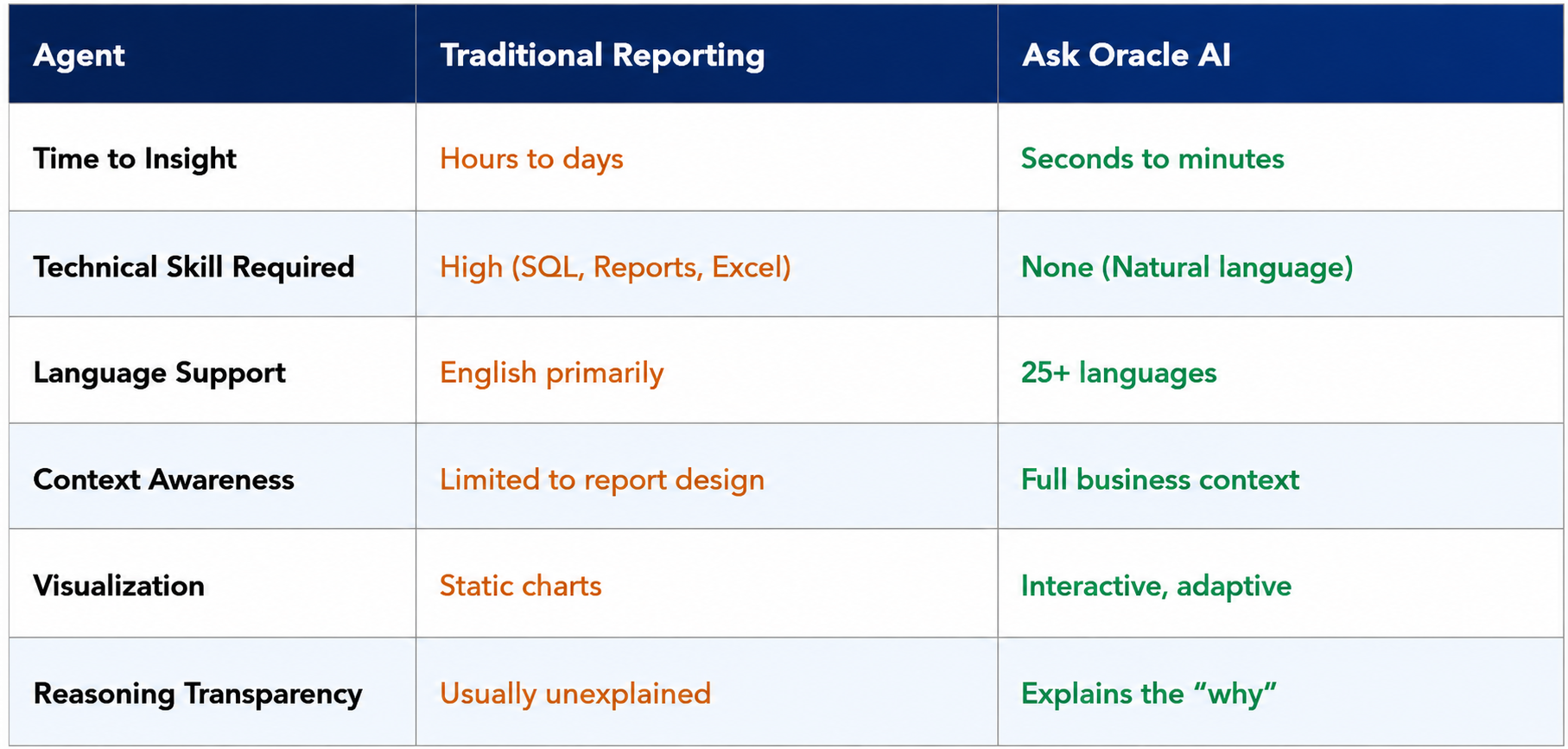
The most important feature of NetSuite Next is Ask Oracle, a conversational AI assistant that is essentially changing the user experience in their ERP. Rather than having to use complicated menus or study report syntax, teams can query in plain English or any of the 25+ languages supported by NetSuite.
Ask Oracle provides context-sensitive responses, creates queries in real-time, and justifies why each response was answered.
A finance manager may ask, "Which customers have the highest DSO?" and get not only the answer, but a breakdown of the top 10 accounts with trends and recommended actions. A supply chain analyst might ask, "Give interactive insights of products that might experience stockouts during the next 30 days," and receive detailed insights with recommended actions.
Creating regular and quality business content at scale has always been a bottleneck. Text Enhance automates it by using generative AI on text fields across NetSuite, which assists staff members in writing descriptions of customers, product listings, emails, and compliance documents more coherently and quickly.
The real-world impact is substantial:
AI automation NetSuite continuously scans your financial data, identifying anomalies that might indicate fraud, processing errors, or unusual business activities. Rather than manually reviewing thousands of transactions, finance teams receive intelligently flagged exceptions with recommended corrective actions.
This capability transforms financial control from reactive to proactive.
All of this, along with AI-generated rationales on why the system raised the alarm. The most important exceptions can then be examined by teams first, instead of drowning in false positives.
Traditional automation in NetSuite (workflows and scheduled scripts) is rigid. It executes exactly what you tell it to do, nothing more. Rigid automation fails when the business processes are modified or exceptions arise. Agentic workflows are different. They understand context, adapt to exceptions, and learn from each cycle.
So, what's the key differentiator? The human-in-the-middle approach. Agents don’t exist in a vacuum;
Such a balance between control and autonomy is essential to implementation in regulated industries.
Agentic workflows in NetSuite are not yet fully autonomous. They operate best in well-defined processes with clear rules and measurable objectives. They require strong governance frameworks to function reliably.
And critically, they amplify data quality issues. Poor data in equals poor decisions out. Organizations implementing agentic workflows benefit significantly from partner-led governance design workshops and ongoing monitoring to ensure agents perform as intended.
The announcement of these features doesn't mean they're available everywhere immediately.
Current Availability (as of May 2026):
NetSuite Next and generative AI capabilities are in phased rollout following the October 2025 announcement. Oracle has not confirmed a general availability date, but wider availability is expected in late 2026, according to general NetSuite release schedules. (so approximately Q4 2026)
Generative AI features such as Text Enhance, Prompt Studio, and SuiteScript AI APIs are available in EU environments, with support for EU data residency and compliance.
Availability in other regions is expected to follow through 2026–2027. Limited access and preview are likely to happen before the general availability.
The impact of AI in NetSuite varies significantly by department. Understanding where NetSuite artificial intelligence creates the most immediate value helps prioritize implementation.
Before adopting NetSuite AI features at scale, organizations should be aware of what these features are unable to accomplish with reasonable certainty yet.
Large language models have token limits and constraints on how much data they can process in a single request.
For example, if you ask Oracle to analyze 12 months of transactional data across multiple reports simultaneously, it may return incomplete results or hallucinate data. These limitations require careful system design around data preparation and context management.
AI automation NetSuite amplifies whatever data quality issues exist in your system. When customer databases include inconsistent naming conventions, duplicate records, and a lack of records, AI-based recommendations are less accurate.
Before scaling the conversational AI NetSuite deployment, audit and enhance your core data. This data readiness assessment is a critical step where partner expertise prevents costly mistakes downstream.
Agentic workflows require governance. The "human in the middle" approach isn't optional; it's necessary. Defining the following is important:
The 2026 AI roadmap of NetSuite goes beyond NetSuite Next. Several major improvements are underway:
Natural language interface for scenario planning. Ask "What happens if revenue decreases by 10%?" and get automated forecasts, which allow real-time stress testing.
Through intelligent agents, regular month-end reconciliations are done with minimum human involvement, enabling organizations to complete the 3-4 day close cycles on a consistent basis.
The AI-generated financial narratives describe trends of variance, rather than report numbers, and assist the leadership in knowing "why" behind performance.
Support for the creation of content in any language that NetSuite supports, making it a truly global service without translation bottlenecks.
Improved SuiteScript functionality, code generation support, and easier code creation through agent development.
This is one of the most important extensibility announcements. By retaining its own AI logic within NetSuite, organizations can implement their own AI workflows without leaving the security and governance model of the platform, enabling custom AI workflows that don't require extensive integration overhead.
To successfully implement these advanced capabilities, it is necessary to have partners who have extensive knowledge of both the NetSuite platform and AI integration patterns.
The future of enterprise resource planning is smart, conversational, and increasingly autonomous. AI in NetSuite is not a nice-to-have addition; it is a core shift in how organizations do business.
Those who start planning today by doing data quality audits, governance definitions, and finding the high-impact use cases will enjoy value much sooner than those who are caught off guard.
The organizations that get the most from AI in NetSuite are not the ones who move fastest. They are the ones whose NetSuite environment is already built for it.
Tvarana's native SuiteApps are embedding AI where it creates immediate value today. SkyDoc automatically reads, classifies, and matches documentsto the right NetSuite records the moment they are uploaded. Our inventory count assistant lets teams ask plain English questions across thousands of records and flags anomalies instantly. Vendor statement reconciliation, one of the most manual tasks in AP, is now automated with a clean exception report ready for review.
These are not roadmap promises. Most go live inside your NetSuite environment in under a week, with no training data, no templates, and no disruption to existing workflows.
As NetSuite Next rolls out and AI becomes the core of the platform, businesses running native SuiteApps will inherit those capabilities automatically. No middleware. No re-integration. No lag.
Want to see one in action inside your own environment? We can make that happen fast. Talk to us.
The timeline is clear. The capabilities are defined. The question now is: Are you ready?



Tvarana is an award-winning
Oracle NetSuite Consulting Firm
and an SDN partner.
info@tvarana.com